Inside NAEB’s initiatives to boost coffee production and productivity
Coffee remains one of Rwanda’s leading agricultural exports and an important contributor to the national economy. In a bid to contribute to the achievement of Rwanda’s Fifth Strategic Plan for Agriculture Transformation (PSTA 5), 2024–2029, which targets US$160 million in coffee income by 2029, NAEB is stepping up efforts to strengthen coffee production, productivity and the incomes of smallholder farmers.
One of the key pathways towards this target is the rejuvenation of Rwanda’s aging coffee plantations, whose productivity has declined with age. Through the Promoting Smallholder Agro-Export Competitiveness Project (PSAC), NAEB is implementing a coffee replacement and rehabilitation programme in six pilot districts: Karongi, Nyamasheke, Rusizi, Nyamagabe, Huye and Ruhango.
Over six years, old coffee trees aged more than 30 years are to be uprooted and replaced with high-yielding coffee seedlings across 3,050 hectares, while coffee trees aged more than eight years will be rehabilitated across 1,082 hectares. The rehabilitation is aimed at improving the vigor and productivity of existing coffee trees while supporting the production of better-quality coffee. Together, these interventions are designed to increase yields, improve coffee quality and strengthen the long-term competitiveness of Rwanda’s coffee industry.
Producing and planting high-yielding and climate resilient seedlings
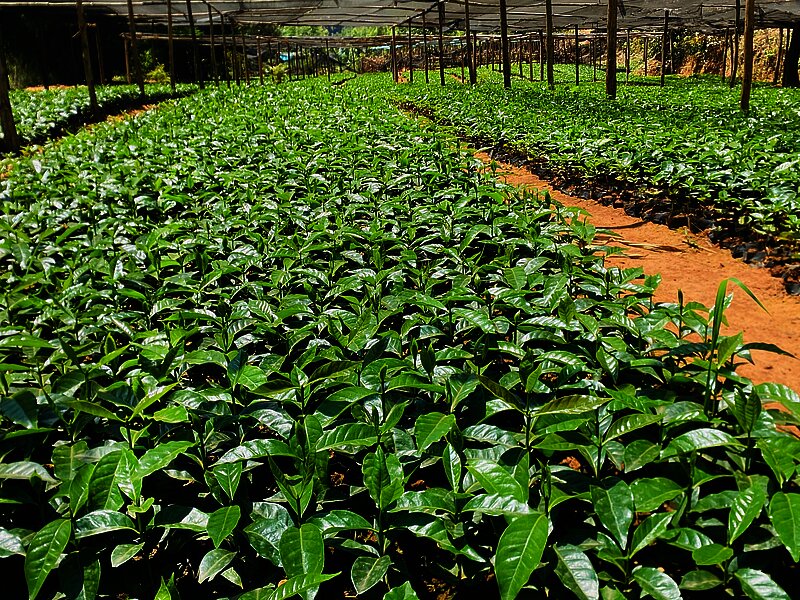
Over the six-year programme, 9 million coffee seedlings are expected to be planted in the areas where old trees have been uprooted across the six pilot districts. To date, over 4 million seedlings have been distributed and planted, with over 3.7 million additional seedlings expected to be planted this year.
Seedling production is being promoted through a community-based approach involving youth and women’s groups, creating income-generating and employment opportunities while responding to the growing demand for quality planting materials. Beneficiary farmers receive high-yielding RAB-C15 coffee seedlings at no cost. Under appropriate management, the variety is expected to start producing after about two years, allowing farmers to begin benefiting from the renewed plantations relatively early.
Combining inputs with knowledge
Under the initiative, farmers also receive fertilizers at no cost and benefit from regular training in improved coffee production practices through extension services and Farmer Field Schools (FFS). These interventions equip farmers with practical knowledge of improved agronomic practices, enabling them to make better use of the inputs provided and improve the performance of their coffee farms.
From rejuvenated trees to improved livelihoods
By increasing productivity and supporting better-quality coffee production, the initiative is expected to contribute to improved incomes for smallholder farmers while creating opportunities for young people and women along the coffee value chain. For NAEB, the ultimate goal is to build a more productive, competitive and sustainable coffee sector capable of generating greater value for farmers and contributing to Rwanda’s agricultural export ambitions.