NAEB drives agri-export sector growth with over 11 million seedlings to be planted in 2026 A season
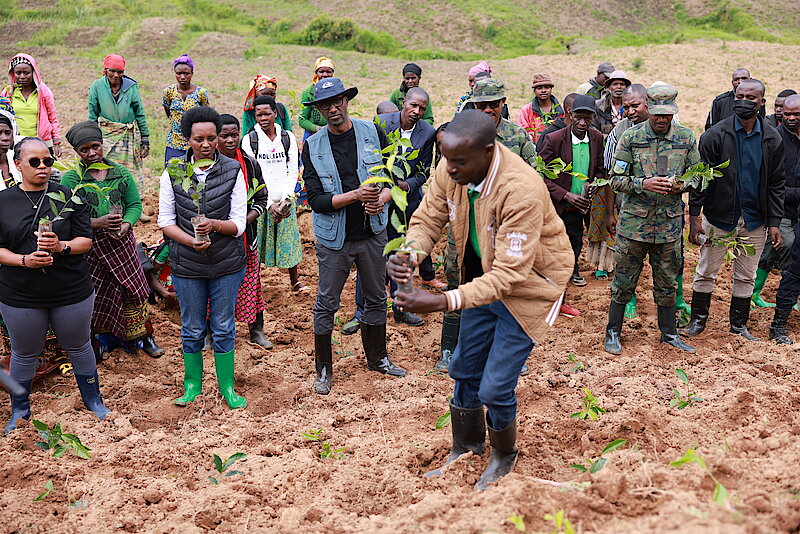
NAEB has officially launched the 2026 A planting season for agri-export crops—including tea, coffee, and horticulture—across 13 districts where the PSAC Project, implemented by NAEB, operates. Through this flagship project, NAEB prepares and distributes high-quality seedlings to beneficiary farmers to boost production.
The official launch took place in Rutsiro District on 12 November 2025, where NAEB CEO Claude Bizimana joined district officials and residents to plant tea seedlings as part of the gap-filling activities in existing tea plantations. In this district, 2,310,000 tea seedlings will be planted on 150 hectares this season.
“We urge all beneficiary farmers to properly manage the seedlings they receive so that these investments translate into higher yields and better-quality exports,” said NAEB CEO Claude Bizimana.
Tea planting activities are also underway in five additional districts where PSAC Project is supporting the development of tea farming—Nyamasheke, Karongi, Nyabihu, Rulindo, and Nyaruguru—where a total of 8 million seedlings will be planted in the 2026 A season. By 2029, when the project concludes, PSAC will have supported the planting of 40 million tea seedlings across 2,410 hectares.
The launch also marked the start of planting 2,902,145 coffee seedlings across six districts—Nyamasheke, Karongi, Rusizi, Nyamagabe, Huye, and Nyaruguru—as part of the national program to replace old coffee trees (over 30 years old). This year, coffee replacement will cover 1,043 hectares, with a long-term target of planting 9 million seedlings on 3,050 hectares by 2029, along with the rehabilitation of an additional 1,082 hectares of old coffee trees.
Under the PSAC Project, horticultural planting has also begun in seven districts—Rwamagana, Bugesera, Nyanza, Huye, Rusizi, Karongi, and Rutsiro. In total, farmers received and are planting 150,000 avocado seedlings, 45,000 mango seedlings, and 10,000 macadamia seedlings during this season.
A Tea farmer in Rutsiro District of Western welcomed the initiative, noting its economic significance:
“These seedlings come as a major boost for our communities. They will increase productivity and help farmers secure better incomes in the coming years,” Bitonda Boniface remarked during the launch.
NAEB CEO urged farmers who received seedlings to ensure their proper management and care so that they yield the expected quantity and quality produce, and pledged NAEB’s continued support through technical guidance, provision of agricultural inputs, and advocacy where needed to ensure that this transformational initiative achieves its intended objectives.
This large-scale seedling production, led by PSAC-supported women and youth, along with the free distribution and planting efforts, is expected to significantly boost Rwanda’s future export volumes and improve the livelihoods of smallholder farmers across districts where PSAC Project intervenes.