NAEB launches nationwide coffee rejuvenation and maintenance campaign to boost productivity
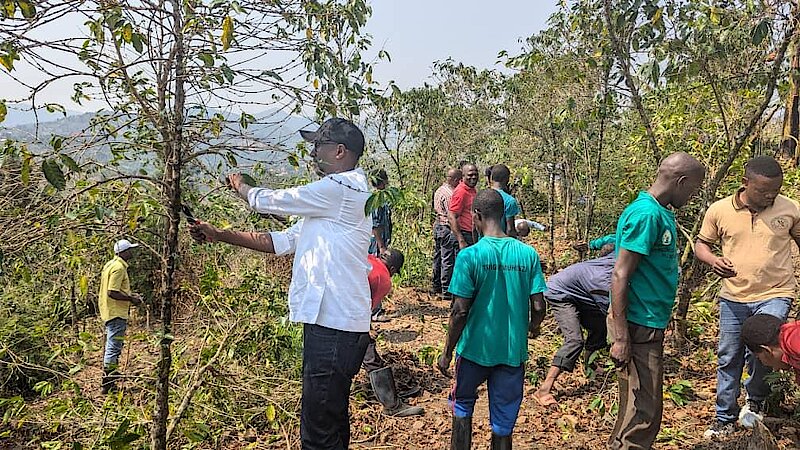
The National Agriculture Export Development Board (NAEB) has embarked on a comprehensive nationwide campaign to rejuvenate aging coffee plantations.
This ambitious initiative is part of the ‘Promoting Smallholder Agro-exports Competitiveness project (PSAC), implemented by NAEB, aimed at boosting the currently declining coffee production.
Launched in in Huye and Karongi Districts in Southern and Western Provinces respectively, this campaign, which aims to revitalize Rwanda’s coffee industry, is set to continue in other coffee-growing regions across the country.
Coffee rejuvenation involve coffee pruning, cutting for re-sprouting, and renovating the plantation by uprooting old trees and planting better varieties of climate-resilient coffee seedlings.
Coffee is one of Rwanda’s most important cash crops, playing a critical role in the country’s economic development. Over the past six years (2017-2023), Rwanda has earned over $452 million from coffee exports, with more than 113,000 tons of coffee sold to international markets.
Despite this success, a significant portion of Rwanda’s coffee trees—nearly 30%—are over 30 years old and past their prime. These aging trees have led to a decline in productivity, prompting the need for rejuvenation and expansion of coffee plantations, which currently cover 42,229 hectares.
In the course of this coffee revitalization process, the PSAC Project, which will run for the next five years, will provide farmers with technical support, free seedlings and fertilizers, and incentives for uprooting old trees, among others forms of assistance.
The PSAC Project will provide a timeline that enables farmers to take ownership and effectively manage the rejuvenation of their coffee plantations. The plan involves gradually uprooting old trees while waiting for newly planted seedlings to mature, a process that takes three to four years.
This approach is designed to minimize disruptions to farmers’ incomes, ensuring that they can continue to rely on coffee farming as a source of livelihood during the transition period.
Addressing coffee producers, farmers, and local authorities in Rubengera Sector during the campaign, Claude Bizimana, the Chief Executive Officer of NAEB, stated that the initiative aims to increase productivity and mobilize people to benefit from the rejuvenation and rehabilitation of coffee trees.
“We are replacing aging trees, some of which are 30 years old, and others planted during colonialism. This is in line with scaling up coffee production,” Bizimana said.
1,000 hectares will be restored, replacing 3,000 hectares of aging coffee trees within 14 districts with most of the aging coffer trees. It is expected that the upgrading and restoration of coffee trees will see Rwanda’s coffee production triple.
Link to more details about the campaign: https://www.youtube.com/watch?v=cijvSaH21Iw